Table of Contents
From retail to field work, tablets have become an essential tool in most industries, helping businesses increase productivity and streamline operations. However, not all tablets are created equal!
Tablets fall into two main categories: ruggedized tablets and consumer grade tablets. Depending on your business needs, choosing the right type can mean the difference between a smooth and efficient process or costly downtime.
So whether you’re a professional looking for a rugged and reliable device, or an individual looking to understand the differences between the two, this guide will provide valuable insights to help you make an informed decision.
The Difference Between Rugged Tablets and Normal Tablets
| Feature | Rugged Tablet | Normal (ConsumerGrade) Tablet |
| Durability | Meets militarygrade MILSTD810H standards; IP65/IP67 rated for dust/water resistance; shock and droptested up to 1.5 m or higher | Basic scratchresistant glass; minimal dust/water protection; not droptested |
| Customization Options | Modular ports (e.g., RS232, GPIO), integrated barcode/RFID scanners, GNSS modules | Fixed hardware; no industrial I/O expansion |
| Battery & Power | Highcapacity swappable batteries for 8–12 hrs continuous use; hotswap capability | Builtin battery, typically 6–8 hrs; no hotswap support |
| Display & Touch | Highbrightness (≥ 800 cd/m²) sunlightreadable screens; glove and wetfinger touch | Standard 300–500 cd/m²; capacitive touch only |
| Operating Conditions | Operates from –20 °C to 60 °C; survives 95% relative humidity | Typically 0 °C to 35 °C; limited humidity tolerance |
| Weight & Form Factor | Heavier (0.8–1.5 kg) with reinforced housing | Lightweight (0.3–0.6 kg); slim, sleek design |
| Price Point | Premium pricing reflecting industrialgrade build and support | Affordable consumer pricing |
What Is a Rugged Tablet PC and Its Characteristics
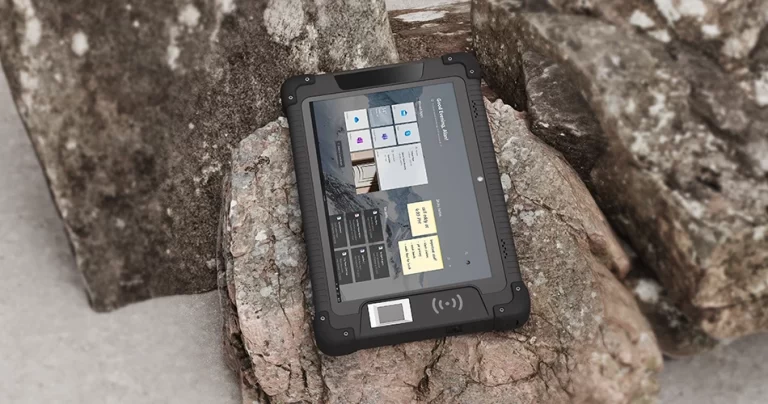
Rugged tablets are purposebuilt for demanding, missioncritical environments in industries such as manufacturing, logistics, construction, public safety, and energy. Their design and features ensure uninterrupted operation even under the harshest conditions.
Durability (ThreeProof Protection)
Drop & Shock Resistance: Built to withstand repeated drops from 1–1.5 m onto concrete without functional damage.
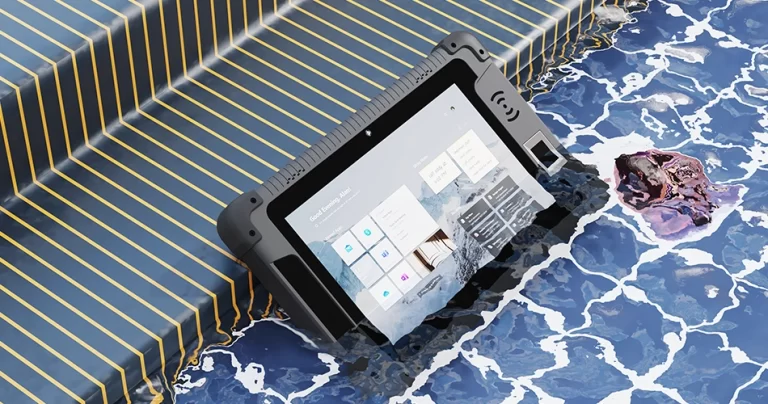
Ingress Protection: IP65/IP67sealing against dust ingress and water jets or immersion.
Temperature & Humidity: Fully operational from –20 °C to 60 °C and up to 95% noncondensing humidity.
Rugged Tablet Customization Options
Modular Expansion: Choose builtin barcode scanners, fingerprint identification,RFID readers, serial ports (RS232), Ethernet, or GPIO.
GNSS & Connectivity: Optional multiconstellation GPS/BeiDou/GLONASS modules for precise outdoor positioning.
Accessory Ecosystem: Docking stations, vehicle mounts, hand straps, and protective cases tailored to your workflow.
LargeCapacity Battery & Long Endurance
Battery: Usually equipped with an 8000mAh or 10000mAh battery, and equipped with fast charging, it is very suitable for 24/7 continuous operation.8–12 Hours Runtime: Under typical usage scenarios (scanning, data entry, wireless connectivity).
Waterproof Rugged Tablet&High Brightness Sunlight Rugged Tablet
High Brightness: ≥ 500–1,000 cd/m² for clear visibility under direct sunlight.
Glove and WetFinger Touch: Specialized capacitive or resistive touch that functions with work gloves or in wet conditions.
What Is a ConsumerGrade (Normal) Tablet PC and Its Characteristics
Consumer tablets prioritize style, multimedia performance, and affordability. While perfect for everyday entertainment and general office tasks, they lack the robustness required for industrial settings.
Portability & Slim Design
Ultrathin profiles (6–8 mm) with weights under 0.6 kg, optimized for handheld use.
Rich Configurations
Wide variety of SoCs (Qualcomm Snapdragon, Apple Aseries), RAM (4–16 GB), and storage (64–512 GB).
High-resolution Retina or AMOLED displays delivering vibrant colors.
High Resolution & Multimedia Focus
2K–4K displays (2,000–4,000 pixels across the diagonal) for crisp video and image rendering.
Stereo speakers and front/back cameras tuned for consumer photography.
How to Choose Your Rugged Tablet Correctly
Selecting the right rugged tablet requires matching device specifications to your industry’s demands. Below are key considerations by sector:
Construction & Engineering:
Prioritize drop resistance and integrated GPS for site mapping. Highbrightness display and MILSTD810H compliance ensure data entry even in dusty, outdoor environments.
Logistics & Warehousing:
Look for builtin barcode/2D scanners and RFID. Hotswap battery support keeps workers moving without downtime.
Public Safety & Emergency Response:
Ensure IP67 waterproofing and glove-capable touch. LTE/5G connectivity for realtime data sharing; optional push-to-talk (PTT) radios.
Manufacturing & Quality Control:
Strong EMI shielding and customizable I/O ports (Ethernet, serial) integrate seamlessly with factory equipment.
Agriculture & Field Services:
GNSS multiconstellation support for precision agriculture; extended battery life for all-day field use.
Medical & Bioengineering:
Compliance with FDA or CE medical-grade standards; easy to clean surfaces and disinfection resistance.
FAQ About Rugged Tablets
What Is the Typical Lifespan of a Rugged Tablet?
A wellbuilt rugged tablet can last 3–5 years in the field, thanks to industrial-grade components and protective designs. Swappable batteries and firmware updates further extend useful life.
How Long Does a Rugged Tablet Battery Last?
Under normal mixeduse conditions (data entry, scanning, wireless), expect 8–12 hours per fully charged battery. Many models support hotswap batteries to enable continuous operation.